

Discovery Zone at Stone Circle Theater
In which we go to see the show.

JJ Weihl has serious savior energy at the onset of her debut performance of the newest Discovery Zone record, Library Copy Do Not Remove. She wears a large, white double-breasted blazer, an angular lavalier microphone attached to her head. It’s giving mega-church. Deliberately disregarding her instructions, the Pattern Seeking Brain removes a copy of this experience, a memory, and here it unfolds. Let my record be a simple, imperfect render.
“Thank you for braving the flood in order to get here,” she says, winking to the crowd in the Stone Circle Theater, a few of whom managed to snag pew seats, while a crowd of some hundred or so fill in behind. It’s a packed house for this curious new work, not quite an album, per se, and certainly nothing like the nostalgic city pop on 2024’s Quantum Web. Commissioned for a sound installation at the Zeiss-Groß Planetarium in Berlin, a structure that is itself shaped like a gigantic white eye built from metal cells, Library Copy is almost entirely instrumental—a floating mass, sound congealed together like a thick, gelatinous bubble containing some alien intelligence, observing the Earth and responding in its tonal language. This new record is slow, meditative, and sparkles with artifacts of digital history.
The site of tonight’s performance was once a church. Tonight, it has been transformed into a planetarium. Stars glitter on the dark ceiling, where there may typically be a vision of heavenly light. Another performance is scheduled for later in the week, in Los Angeles.
I’m inclined to Weihl’s conceptual interests: the literature of Borges, quantum physics, nostalgia for the early days of the internet. In 2024 she joined on my radio program Thrust. She presents as a multimedia artist. I take this to mean that the research and concepts are given an equal weight to the musicality and technical performance. There is as much to talk about as there is to sing. The stage is set up for a multimedia presentation of some form...a lecture, or a demonstration. There are recognizable items, as well as other objects that appear to be arcane, the tools of an alchemist. A table holds a loupe, a large hardcover book; a theremin sits on a stand to the side. Behind, acting as the professor’s blackboard, is a projector screen stretched on a frame.
We did brave a flood, by the way. I live about ten minutes up the hill from Stone Circle. It would have been a leisurely stroll had the sky not cracked open. The force of the rain was awesome. It seemed to come as an orgasmic release, after agonizing tension. The streets flooded over the sidewalk. Cƒ- and I hid in a deli on Fresh Pond Road, along with a group of kids in soccer uniforms, a couple in workout gear, and a man who had ended his afternoon jog with the purchase of a bottle of red wine and a frozen pizza. So together we witnessed the first outcry of what by most reports looks to be an angry, petulant summer. El Niño. The kid is back for revenge.
When it pours in New York City, everybody knows. The videos flood in, mostly from parts of Brooklyn and Queens that sit at the basin of slopes. CNN loves this stuff. A woman descends from the bus and is immediately knocked sideways. Her friends cackle and gasp in the background. Cars get stuck at intersections and honk with dumb impatience but, at the same time, in these moments the vehicles have never been more anthropomorphic: they are like armored Serengeti grazers...hippos and gazelles at the watering hole, with big, bovine eyes. When it pours, we dance. We danced and danced down 70th ave, Cƒ- and I, never a puddle breaching the berm of our leather soles. We danced our way to the theater to see Discovery Zone perform Library Copy Do Not Remove.
Time Wharp opened the show. What a pair. That little keyboard with the rubber tube attachment, what’s it called? I always forget. I so fondly remember watching one of the members of Fleet Foxes walking through the streets of Paris in one of Vincent Moon’s Takeaway Shows, the dappled plaster church walls, heavily saturated sunlight washing out the troubadours as they stood in a circle in a grand room with a wooden floor and domed ceiling—this was the space I imagined my adulthood would inhabit, a rustic and sober secret, the abandoned historical turned over to a magisterial new “now!” So this “now” is a moment for magic, bent and forced by electric tools to the whim of the artist...
The melodica, that’s what it’s called. Time Wharp sends it all into a magic box. Signals are transmogrified and grafted onto one another; a fleshy, monstrous sound comes forth. The floor trembles a little. There are endless variations of the loop soloist, the artist who sits alone and places their ideas into a black box, then conjuring forth, one by one, arrangements and harmonies, as if an entire ensemble were stored inside. Time Wharp had variety, variegation; something algorithmic working behind the scenes. The music came back strewn with fissures and cracks, damaged by its journey through the cables. Perhaps, inside the box, the sound had traveled thousands and miles, scraping the contours of some digital landscape and reemerging scratched and buffed.
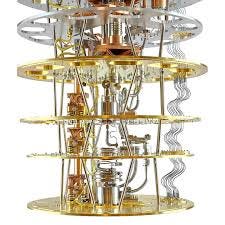
Library Copy Do Not Remove tells a story. A purple eye “passes through holographic chambers of memory, replication, and recognition.” At the center is an eternal, circular library. The suite is accompanied by a film produced by Mark Dorf. Beginning with the birth of a star, the film recedes into a set of endless corridors facing identical doors, a liminal space, not unlike the Eyewitness educational films first aired in 1994, except the tigers and parakeets and toucans are gone, and the eye searches desperately for symbolism in this empty space. The eye descends to Earth and crawls across the planet. Multiple crucial images make an appearance: there is a mysterious base in the arctic circle; a facility at CERN, where a giant cylinder sits housed in a lattice of tubes; a quantum computer, hung like a hornets nest, shines in gold. Through another door is the library, a hexagonal chamber worthy of Borges Library of Babel, in which every permutation of every linguistic idea is written in volumes arranged randomly in infinite rooms, and scholars search for single words and sentences among the random combinations of symbols. The eye visits a museum, or prison, where trees are stored in identical glass containers arranged in endless rows. On a mountainous slope, a human perspective seems to stumble as it moves through rendered trees.
Hands released, Weihl is free to play. Weihl is a great guitarist. The theremin controls some sculpted contour of her vocals, and she draws huge volumes of sound out of the air. The music ascends, there is little percussion driving us forward, so the sound floats, and the audience levitates, the same as this disembodied purple orb, leaving the Stone Circle Theater and visiting these imaginative worlds with their uncertain rendered edges. For one piece, the microphone picks up the rustling pages of a book, as Weihl describes the Eternal Library, holding some device attached to a cable that projects the flat plane of the text onto the projector behind her.
The lav mic is having a moment. It’s the artistic embrace of closeness, and the freedom to gesture and toggle. In this context, Weihl is a scholar of the Eternal Library, and we are students learning. In this context, the lav mic is suddenly the true successor to the SM58. Likely this was the case from the very beginning...we just couldn’t see it. The 2000s had its novel images of the future, after all, the cyberdecks and gooey GUIs, wraparound Oakleys—there was a notion that we would be “on the go”, and we would need to take tech with us. This is the context Discovery Zone inhabits, one in which there is still a future. And it’s funny to think that in many cases, tech has rooted us in place, practically turned us all to stone.
Why didn’t we love the lav mic back then? Most likely, there was some combination of signifiers that made it unserious, uncool. Likely the embarrassment of the Mickey Mouse Club pop stars—Britney Spears, Justin Timberlake and his boy band cohort—killed any amount of sex appeal. There are of course the preachers and the CFOs. We just weren’t ready for something to be clipped to our faces.
You have to remember that for a long time, music was something “cool” people did. Specifically, cool, tough, people. Men. Microphones were for men. Rock musicians were working class (like actually working class), in the US and the UK, and they grew up surrounded by machinery. They worked at car manufacturing plants. Music was extremely physical, horny, and relied on the brutish logic of electric amplification. As a culture we became obsessed with amplification, and an aesthetic vocabulary developed around this weighty, industrial image. In the early days, people didn’t really hold microphones at all. Live sound was finicky, you couldn’t move things around so much. The PA system was prone to feedback. The mic stayed in one place and the singer approached it like a pulpit. That was the technology of the time: a heavy guitar, gigantic stacks of amplifiers (often fake, for the vibes) behind you on stage, you held a large, phallic microphone up to your face. Next came wireless—we went through the Fist Mic era. This was a hip-hop thing. You had to “wield the mic”, as a weapon. You held it cocked at a surly angle. R&B and pop singers have this particular grip, like how you hold a wine glass. It’s very specific. That was then. But now, now, I mean holy shit...now we see Dijon on stage at Coachella, thrashing into the crowd and it was like, yeah, okay, we got something here. He looks cool with a lav. JJ looks ethereal with their apparatus floating in front of her, another sensory sphere taking in data.
And finally, I ask: what can music be? In this theater we seem light years away from the formats I grew up on. It is also different from so many of the inventive systems electronic artists have developed—the cascade of referential samples in Oneohtrix Point Never, the cyborg augmentation of Bon Iver, or the algorithmic jams of Autechre. There is an intimacy to the stage show. Apparently, this is one of only two (2) performances of the entire record. But maybe with encouragement and planning, Library Copy Do Not Remove will come to a planetarium near you.
What a treat