

On Returning to Rome for the First Time
Travel, Betrayal, and Myth on the eve of my return to the Eternal City

For the next two weeks, I will be working with the artist Danny Leyland, who is a resident at the British Institute in Rome. Together we will travel to Antrodoco, near the site of the ancient and mythic Lacus Cutiliensis, as well as the rumored location of the death of two Roman Emperors, Vespasian and his son, Titus. The bulk of my transmissions from this time will be available to paid subscribers, who will be given an early glance into the development of a new collaborative work.
Once a traveler, always a traveler. Some people move from their kitchen to their backyard, look out upon the blue hills beyond their green, weld-wire fence, and from this vantage point they can intuit all of the depth of the world necessary to endure another day, and to perhaps even find joy and security in their life. Others travel to the ends of the Earth and find nothing; they return home expecting a reward that never comes.
As a citizen of the world, holding no nationality and no political allegiances, the Pattern Seeking Brain attempts to meet each place on its own terms. To travel without judgement or preconceptions requires a mix of hubris and ego, humility and benevolence, adventure and idealization, all of which I am equipped to handle (I think). I can be the fool and the American, the idealist and bohemian, the silent partisan and the sober outsider.
It requires great privilege to travel freely. It also requires great privilege to go no place and to know nothing. People are forcibly displaced—they occupy the same terminals and ports as tourists and traders, refugees and wanderers. They eventually settle and establish minor dynasties, their children acclimate and become foreign to them. Languages and traditions become lost. Part of my own family originated in Italy. I am reminded of this aspect of my history, even more so than the nature of my names—Ross is predominantly Scottish, with Gaelic and Germanic derivations, containing many meanings depending on its origin, including horse, and headland, a coastal cliff that extends towards the edge of a landscape; the clan Ross is of no relation, but my last name, Devlin, dates back to the 900s in Tyrone, Ireland—the Italian-ness I’ve grown to embody as an American, having little cultural or traditional connection to the country, likely is assumed due to the color of my skin.
It’s Been 10 Years of Realizing Things
In 2016, a prominent public intellectual, whose family originated in Europe and Armenia, experiences an epiphany. She records a video detailing these revelations. There is nothing else to do but upload the video; she knows that her words will spread naturally, assumed into the thoughts and opinions of others, as a song is repeated and adapted, and for her those who keep their ears open to her words, they carry the essential simplicity of a melody.
Seated on a black leather armchair, Kylie Jenner, a child of conspicuous providence, born into one of American capitalism’s most favored dynasties, an oracle of the flows of consumer capital, outlines a new vision for interpreting the course of time. “Every year has a new energy,” she says. “I feel like this year is really about, like, the year of just realizing stuff.” “Everyone around me,” she says, “we’re all just, like, realizing things.”

notice the skulls….
In the scene, possibly composed by Jenner, but just as likely the careful work of some off-screen advisers, various objects give clues to decipher her prophecy. She holds a cozy mug. Another mug sits on the side table. A dual presence of mugs could suggest—I’m purely speculating here—an anticipated need for more coffee. More coffee than one mug can possibly hold. The cup runneth over—the two of cups, in the tarot deck, represents a union of strong forces, and the enduring power of love. But both of the mugs are empty, suggesting an expectation. Like the empty shoes and stockings left out in the Yule time traditions of the post-animist Christian world, there is room in the cup for more. The sprits will grant more to those who deserve it...the spirits or the ancestors, or God, or Mom & Dad.
Providence comes from unlikely sources, and in the eyes of the oracle it is no esoteric or complicated thing. Blessings simply fall upon those who covet them most.
On a coffee table decorated in a harlequin pinstripe are balled-up nitrite gloves, evidence of recent work requiring a separation between hand and surface. Something delicate was examined up close. A gold candle flickers on the table, and behind it is a second fire. The gas hearth produces a perfect, unwavering fan of cold flames. A pair of dualities: two mugs and two fires, indicating not just a need for warmth and comfort, but also insight.
Leering from the shelf behind Jenner is third dual image: two dimorphic skulls face the audience as she speaks. A common specter of the vanitas, a Renaissance painting format invoking the gravity of mortality, the Memento Mori is a stark, unambiguous symbol, reminding us that the veil of life is fragile and ephemeral. Behind the curtain, death awaits. Even for Kylie Jenner.
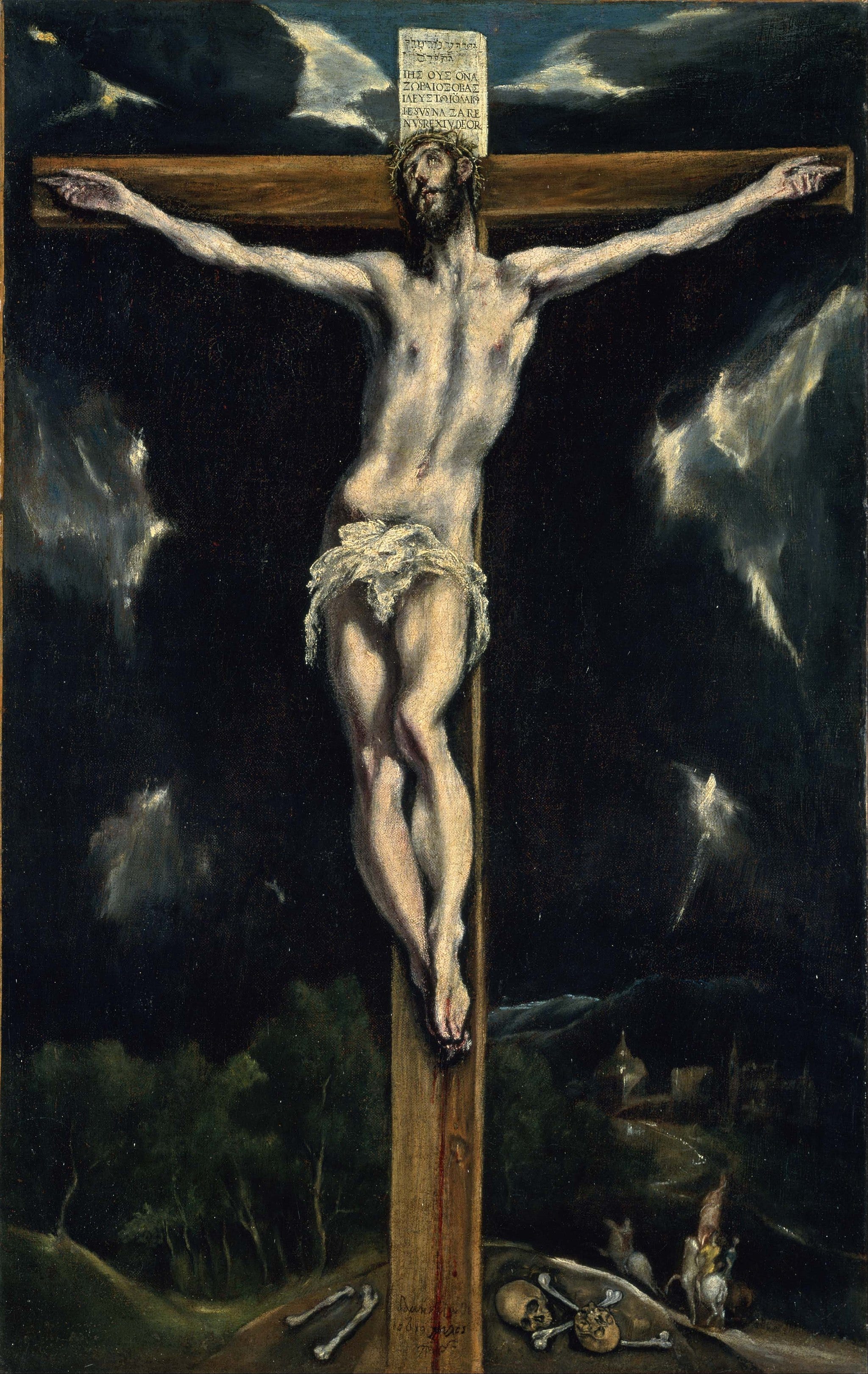
El Greco, active during the time of the Rennaissance, though considered to be a early progenitor of a much more modern style, here depicts the two skulls of Adam & Eve.
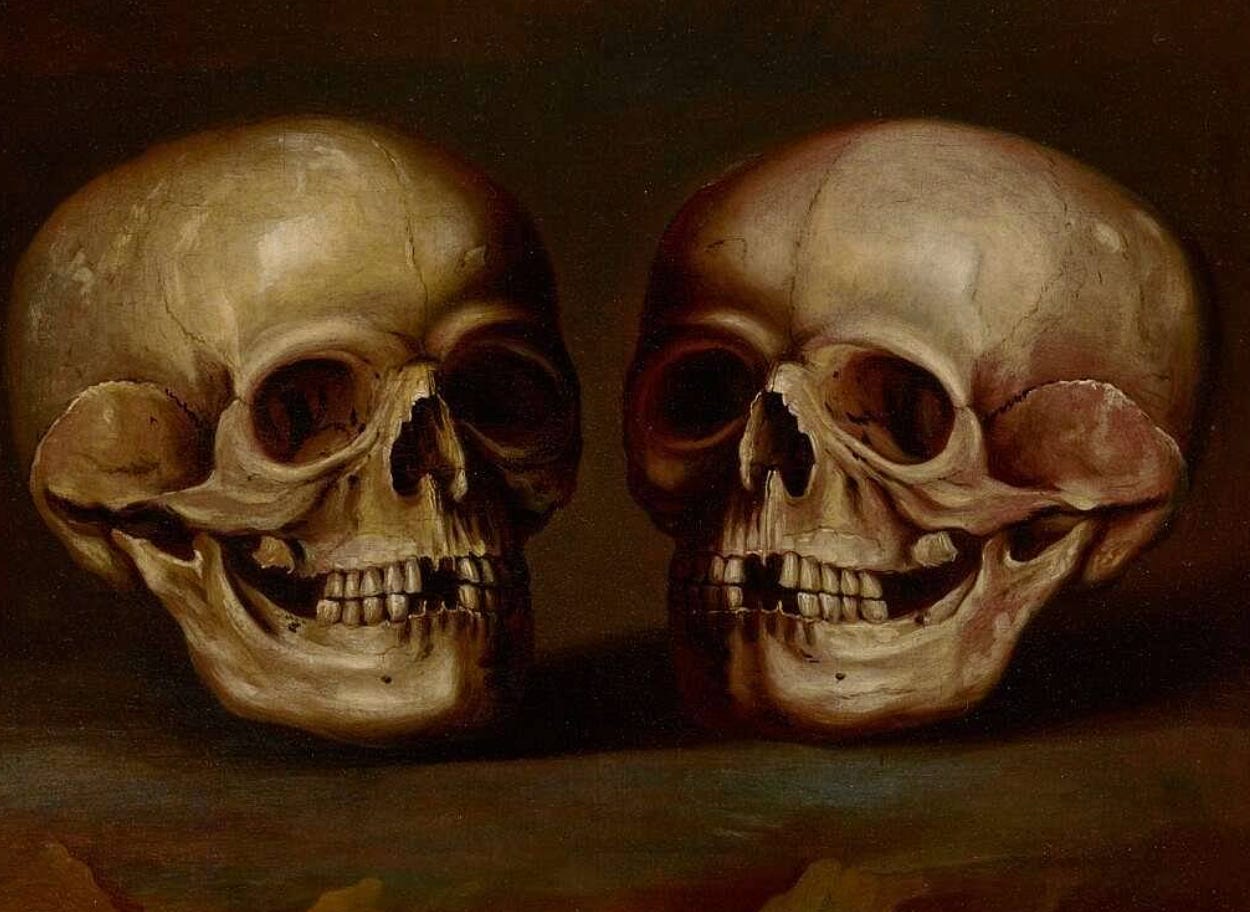
This depiction from Circle of Philippe de Champaigne, dated 1650, is on display at Musée de Tesse in Le Mans.
Periods of tremendous upheaval are often given names as historical markers. In Ancient Rome, the year 69 AD is marked as a violent transition of power, away from Nero, who oversaw the end of the first imperial dynasty in the Year of Four Emperors, all of whom were murdered or committed suicide except for Vespasian, who took power on July 1, and succeeded in ushering in a new period of dynastic stability. Almost two millennia later, 1969 was the “Summer of Love”, characterized by the superficial embrace of psychoactive chemicals and sexual liberation, greater rights for women and people of color, as well as the deadly battles that ensued between the State and activists defending their democratic rights.
So 2016 was the year of “Realizing Things”. 2018 was the “Year of the Scammer”. In 2019 we were visited by “Hot Girl Summer”. Seeing an opportunity to elicit public attention, Tom Hanks’ wayward, carribophile son Chet, dubbed 2020 “White Boy Summer”. Most recently there was “Brat Summer”, arriving with sudden, garish mania, accompanied by a color green as delightfully juvenile as it was foreboding. The green of Brat Summer is the color of goblins, of toxic slime, and of Radium, the radioactive chemical element that was once painted onto a variety of everyday household products. We innocently touted its magisterial glow, unaware that the cursed material would begin to soften bone, piercing the body like an invisible hail storm. Exposure to even small amounts of Radium, over time, leads to a painful, slow death.
Here’s What I am Going to Do
Let me temporarily forgive myself for my hubris. Let 2026 be the Year of Doing Things. The Summer of doing. This summer I will release my 3rd book, a product of two years of work, and the largest and most intimate project I’ve participated in. The journey I took to get there has been an immense privilege. In time I will reveal more.
In the immediate term, I’m going back to Rome. The last and only time I visited Rome was in 2014, during a long layover. I took a train from the airport and met friends in the city center. We wandered without direction and passed in front of monuments to past civilizations. In between the sculptures, fountains, and grand constructions of bread and circuses were more ordinary, contemporary expressions of every day life: graffiti in the alleyways, stalls selling trinkets and cheap wine, human shit and piss laid just out of sight of the passing crowds. There was the sweat that is so common on tourists, who passed in front of the café where we sat and willed away gentle hours, their respective origins and nationalities revealed in small clues—the length of their pant legs, the brand of their sneakers and backpacks, and whether or not they carried large plastic water bottles decorated with stickers. I left Rome that night, boarding a flight to Casablanca, Morocco.
The Rome I intend to return to is the setting of Fellini’s 8 1/2 and Satyricon, Sorrentino’s La Grande Bellezza. It is a giant municipal center of global business and the epicenter of a tourism in ancient history. It is the place observed by Robert Musil in his “Posthumous Papers of a Living Author”, the recordings of a wanderer displaced from his home country by the Nazis, drawn to the small idiosyncrasies of flies and monkeys, tomb stones and low talkers of the late night. It is the eternal city within which holds the world’s smallest sovereign state, the Vatican, an enclave dedicated to the service of the Catholic God’s emissary on Earth (who is, at this time, an American named “Bob”).
There are many Romes that may reveal themselves to me. There is the Rome of contemporary art, advertising open calls, Q&As, performance nights and engagements presented in a similarly cosmopolitan style to the artist engagements of Berlin, London, and New York, which are doubtless the Eternal City’s peers. There is the Rome of the permanent revolution, dedicated to radical economics and politics, which stands in solidarity to the ongoing massacre of Palestinians, as the Italian military remains culpable for their lack of protection to the flotilla delivering aid to Gaza (although Prime Minister Giorgia Meloni suspended their military partnership in April of this year, years too late to prevent the destruction of entire cities, and the displacement of millions). Like many nation states whose history have included civil turmoil, flirtations with the dark obsessions of fascism, and personal enrichment through colonization projects, Rome exists as a citadel of ascendant powers whose layers become murkier the higher one climbs. At the bottom of this tower are ordinary people who make their living, and during they night, they may toast to love or success, to freedom, or defiance.
The Autumn of Emperors
This Rome I attempt to discover is the Rome of Titus, who became emperor on his 39th birthday, and presided over the construction of the Coliseum, as well as the fallout to the eruption of Vesuvius and the 80 CE great fires, before suddenly falling ill during a trip to his vacation home just two years into his reign.
Titus had crystalized his political power in the eyes of the Roman Empire when he was just 31, the same age I am now, when he destroyed the city of Jerusalem and their holy temple, killing thousands, and returning to Rome with over one hundred thousands Judean citizens, taken as slaves. Over fifty years later, it was suggested in writings by Suetonius, the secretary to Hadrian (a source whose objectivity has come under scrutiny) that Titus’ death was caused, or at the very least abetted by his brother Domitian, who lived in the shadow of his fathers legacy, and saw little of his emperor brother, as they were 22 years apart in age. Domitian wore wigs to hide the shame of his premature baldness. He was described variously as cunning, effective, and deeply cognizant of military matters—also intellectually lazy, prone to petty jealousies, and emotionally unstable.
According to one telling of the end of Titus, Domitian contracted the services of an unwitting assassin. Word passed through intermediaries, descending the chain of Domitian’s envoys and consuls, to reach a young man of fifteen, who lived in a shack on the Mediterranean coast, and worked for his father as a fisherman. The young man was approached at a bar where he frequently spent evenings playing cards and games of chance, and he was offered a substantial payment that he never received. The youth, as he would be classified by today’s standards, knew his task well, having a lifelong familiarity with the shores of Lazio, and he went by torchlight to a hidden beach, at low tide, to hunt the soft, shell-less snail that swims on soft black wings, a hermaphroditic blob that mates in grand orgies of hundreds, and whose diet of seaweed produces a toxicity that causes motor failure, convulsion, and fever. With his torch embedded in the sand, the boy slit open the black body, large and pulsing like a human heart, and collected the secretion of the sea hare in a clay bowl. Mixed with wine, this poison was delivered to Titus. The nameless assassin, having no knowledge of his crime, was later visited at the same bar by suspicious figures, whose garments, according to eye witnesses, seemed conspicuously ragged, as if they were costumes. The boy proceeded to get drunk with these unfamiliar men, who claimed to be merchants, and departed with them. The next morning, his body was pulled ashore in a net brimming with fish, his throat cut lengthwise.
The location of Titus’ death remains unknown to contemporary scholarship. But thousands of years later, rumors of a sunken villa in the hills outside of the Eternal City drew the attention of archaeologists. It was always common knowledge to the residents of Castel Sant’Angelo that the concrete ruins protruding from the stramma, mellow, and wild pepper growing through its pores was a grand villa belonging to the late emperor, inherited from its initial construction two centuries before his birth, and extensively renovated to suit the leisure of the time, which included running hot water, bathing pools, and heated floors. Erased from the landscape by an earthquake, the diggers began to unearth this site in 2011, in an ongoing project that continues today under the supervision of the Archaeological Institute of America and the Canadian Saint Mary’s University. This, too, is the Rome that I seek.