

Watching the Long Century: Motion Sickness of Time Travel with Ben Lerner, W.G. Sebald, and Christian Marclay.
I travel to meet my past selves in the Brooklyn Museum, MoMa, Tate Modern, and Blackford Hill.

Clocks
Midnight on the clock face. The new world struggles to be born.
“So will this new world be the product of two lovers, nestled in revery? Or is this some deeper manifestation…a thing that begets itself, that chooses, from a vantage of both future and past, to arrive, like a dormant insect, when it deems the conditions right? If the end of the world is one second away from occurring, then all should be well, right? Because in order for time to run, first it has to cross half the distance between the onset and the end, and then it has cross half the distance between the second half distance, and then half the distance of……”
After a long day of fantasy and distraction, the philosopher shut himself in his study to commit to paper a question: when exactly does something happen?
During the day, the philosopher dreamed of cheating on his wife with one of his students, many years his junior, many standard deviations his intellectual inferior, many synapses short of a fully-developed adult brain, all inequities he would be willing to overlook should this student express a passion equal to his own. Let them meet in the middle. Let the samaras of love waft across the room and tickle the hairs in my pink swelling heart, he would think. The philosopher did not know when something was going to happen, but he did understand that with patience and alertness one may notice something happening, and respond accordingly.
Other people, he thought, often made decisions for you. They do this entirely on their own. All you have to do, he thought, watching a flock of pigeons alight from the rooftop on the other side of the park in front of his office window, is stand in front of the door. Eventually, the door will open on its own. Then you walk through.
▷
Cƒ- and I went to the Brooklyn Museum to see Christian Marclay’s new film, Doors. I had anticipated this event, in some way. I knew it would happen—that I would sit down in a dark room and once again acquaint myself with this great artist, whose face, history, and preferred media I knew so little about—just that I would be there. I didn’t know when, or where.
I knew that I would someday see Doors because I enjoyed The Clock, Marclay’s previous film, which I simply stumbled upon one day in London, in 2018. The Clock is something truly massive—a masterpiece, you could even say—and it is unusual to me, especially in an age like today, that something so encompassing would appear to me out of nowhere. It was as if I had wandered into an unknown neighborhood, taking on chance an alleyway that passed right beside the road to which I was accustomed, and this alley led me into some new sector of a city I thought I knew well, to a place for which I had no precedence, either in photographs, or posts or anecdotes or rumor, and then just as I turned a corner into an open square, I see an airplane. Voilà!
Maybe it feels unusual to be surprised because our world is so captured by the hubris of certainty.
There are no undiscovered mysteries, we are continually reminded. We just roll downhill, collecting speed as we approach a ramp cantilevered over naked, empty space.
So maybe in order to understand something new about this kyanized corpse of a world, we could blow it wide open, taking thousands of individual slice.
Marclay encouraged me to think outside of time and events, which together are perceptibly intractable (like our philosopher, I see what I want to happen, what is happening, and what has happened, but never more beyond the scenarios and strategies I can put to paper) but through art the experience of time, within which exists our physical theater of continual change, may be suspended and held up, like a glass globe with a swirl of floating dust contained within, whose individual surfaces can be inspected for substance and meaning.
My Question is:
How many pieces of time do we need in order to determine that something has happened?
In his new novel, Transcriptions, Ben Lerner gestures to the most discrete unit of experience, of events concerning time and occurrence, our Philosopher’s Measurement Problem, which is the paradox of how quantum events can exist in a state of superposition, yet are instantly resolved upon observation:
“Yes. No one ever leaves a theater. A black box theater. Like the black box of an airplane. That is recovered. Like Schrödinger. The superposition of theaters…or like the cave artists of Patagonia, who, nine thousand years ago, blew pigment from their mouths, creating a halo effect around the hands they held against the wall of their cave. When the black box is opened in one universe, a dead cat is revealed. In the other universe…”
The speaker, Thomas, whom we understand to be a renowned intellectual in his 90s, trails off here. It should be understood that Thomas and the narrator are engaged in play. They are, in fact, discussing a stage play, a play within the play of the novel, in reference to which the narrator has presented a curious image of quantum entanglement, namely the notion that he is “still there”, in the theater, watching the play in some “other universe”, as if to imply that the world of Transcription is not continuous, in the sense that events and happening layer on top of one another, like soil, with the past lost to memory. Rather, there is the suggestion that all events—all of that which has happened before and now and will happen soon or thereafter—play out continually in separate bubbles of time, and if one possessed some divine ability to pierce the veil of perception, they may walk back into that dark theater they visited decades previous, and see the play happening, the crowd in their seats exactly as they once were, and their younger self, rapt with attention, failing to notice their older self standing in the wing.
Of course in our reality, when you pierce a bubble, it pops.
Neither Thomas nor the narrator are physicists by profession, so we understand that their intellectual reparté is primarily one of language: they are exchanging mimetic concepts—symbolic constellations, thinks the Pattern Seeking Brain—and this conversation occurs less so they can “get to the bottom” of something than to ease the two characters back onto a shared gravity. They are two fallen leaves, and they must settle onto moving water, so they may traverse this river of time in sync.
Transcription has much more to say about families than it does about the measurement of time and causality (at this point, though, it seems like these things are inseparable, doesn’t it?). But the novel’s invocation of “black boxes”, these tools of data collection and measure to which we have no access, draws us into the discrete world of the measurement problem, where scientists have been working diligently over a century to render time to its most base unit, first for the purpose of global synchronization, and then to achieve higher orders of sync, at atomic intervals that occur far below our realm of perception.
To understand the intervals of time, I had to travel back to Edinburgh, to try and meet my past self.
00:00:00.00000000
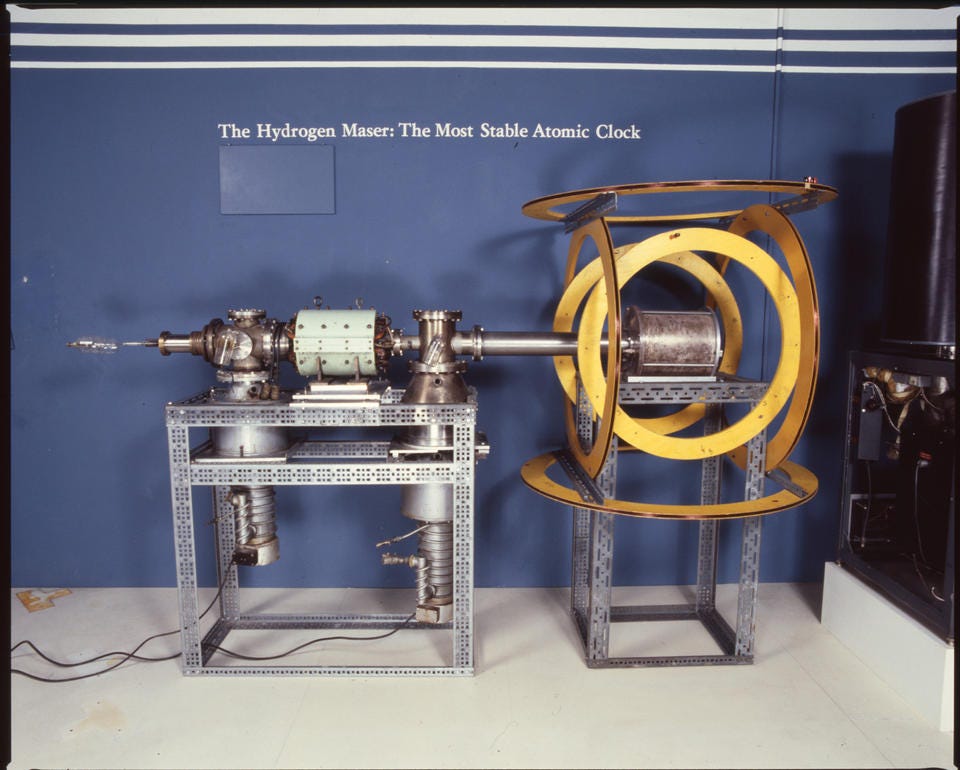
image: National Institute of Standards and Technology
In the past, the synchronization of clock time was not a “problem.” We used the sun.
Of course, there might have been some instance where, say, a premodern man was expected to be home by a certain time, and wasn’t, and this was an issue within his household because it had been happening quite a bit lately, this lack of consideration, and his excuse, that he was coming from far away towards the East, and because Earth is curved the evening occurs later relative to his home, this excuse was considered unsubstantial, either because the household didn’t believe in the curvature of the Earth, or they couldn’t come to terms with relativity, or they simply didn’t care, because they had slowly come to suspect that (based on a variety of intuitive and sensory signals) the premodern man had in fact been very close by the whole time, and was simply spending his afternoons at another household, and lying about it.
In this hypothetical case, it is probably important that the premodern man and his household establish more honest communication strategies, rather than say, inventing a way to “synchronize” clocks.
And specifically, what we mean by synchronize is the invention of a new form of time that may persist in tandem to solar time, with both instruments tracking orbital paths like toy cars on a track, occasionally meeting up, but often slightly ahead or behind one another.
In the beginning of the 19th century, clocks were indeed synced to local sundials, meaning individual towns were in some cases minutes apart from one another. It was the introduction of “railway time” that provided the impetus for broadening the zones within which the hands of the clock remain the same. By increasing the speed of travel (i.e decreasing the duration of travel) humans created conditions which drove us to collapse barriers of longitudinal division.
Away from localities that directly observe the sun and use mechanical means to subdivide this observation, towards longitudinal “timezones” that synchronize the entire globe and appeal to globalized institutions such as banks, airlines, and telecom providers over individuals—enter the global headache that is Daylights Savings Time. Some people hate it! Governments still argue about it.
All this is to say, efforts to “synchronize” will likely incur some discrete loss of local temporality. Our bodies react to losing time in the sense that there is some noticeable discomfort experienced. We were once entirely circadian animals.
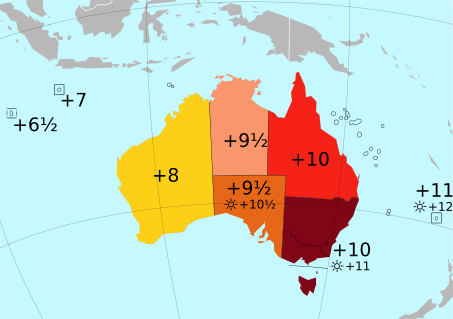
The many time “zones” of Australia
The road towards abstracted atomic measurements of time begins with the Scottish Enlightenment genius, James Clerk Maxwell. Maxwell graduated from the University of Edinburgh, where there is a building dedicated to his name, hidden beside the Braid, a nestled chasm of creeks and forests in the shadow of Blackford Hill. He went on to Cambridge in 1850, King’s College in 1860, and continued to study until an early death at 48. Maxwell sits beside Newton and Einstein as a physicist of incredible prowess. Much of our contemporary world is built on top of his discoveries. Below is the first example of color photography, produced by Thomas Sutton in 1861, based on instructions given to him by Maxwell.
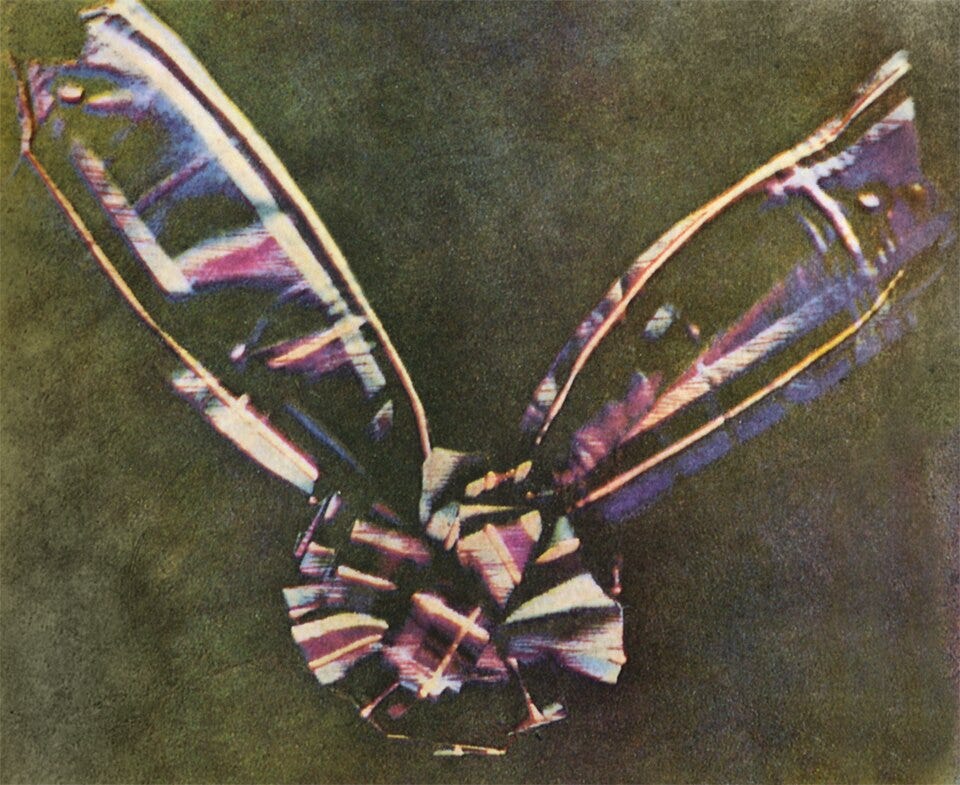
Maxwell was the first to suggest syncing a clock to the vibration of light waves. Adapting and improving upon his principle, today we use a Cesium atom, which ticks at
9,000,000,000 vibrations per second.
Cesium is a soft metal, and melts close to room temperature. Every Cesium atom has the same vibration, no matter where they are on Earth, and this is the jittering slave to which almost every satellite-connected device on Earth receives its time. The pursuit of increasingly fine subdivisions of the second continues, at a laboratory high up on a plateau in Boulder, Colorado. Here, scientists experiment with increasingly arcane, unstable elements such as the rare earth mineral Yttrium, to achieve frequency rates of up to 10^-18.
00:00:00
00:00:00:00
Let’s try to establish what exactly what events we aim to measure.
After all, a film does not play in seconds. It has individual frames, advanced at speed to create the illusion of movement. Film is an expensive medium. The cinematic convention of 24fps was established in the 1920s, as it was found to be a minimum sequence of still images that could achieve veritable smooth movement. This established standard remains a convention in the same way the length of the album of music was standardized at 35-45 minutes (again, a decision made by record companies based on calculations of economy and practicality). It is indelibly associated with the art form in itself. Recent digital attempts to produce movies at higher frame rates are often rejected by the audience as appearing uncanny. Controversially, television manufacturers introduced a feature called “motion smoothing”, which artificially upped the frame rate of displayed media. This decision caused widespread confusion and discomfort—in some ways, a sense of vertigo—and the intent behind the decision was so poorly communicated that Tom Cruise, the patron saint of movies, voluntarily delivered a PSA explaining how you could turn the feature off.
24fps is not the frame rate at which the human eye perceives movement. The eye and the brain work in collaboration to reconstruct images, sometimes referred to as “moments”, likely also adhering to a biological economization of energy use. It has been proposed that human typically perceive 30-60fps but can, in moments of crisis, detect and process up to 200fps. There is some notion of hard physical limits playing a role here. Smaller animals are understood to perceive “moments” at a much faster rate than humans in part because their brains are physically closer to their eyes. This in part explains their vastly superior coordination: dogs catch balls, mice scurry, dragonflies zip over still water, and houseflies effortlessly evade a rolled-up issue of the New Yorker.

Consider the energy constraint. Why are our brains not always tuned to such a fast frequency? Like watching the uncanny smoothness of a high frame rate film, experiencing reality with such detail can be nauseating. Think of that feeling when time “slows down”, perhaps as a glass of water is knocked off the counter, the body reacting reflexively to rescue it; or the moment before a bicycle collides with a moving car, where certain death is avoided in a quick reaction that seems to have arisen with the slowness of a yawn. The brain understands that too much detail is a hindrance.
(photo: The Tate)
24:00:000000000000000000 (hours)
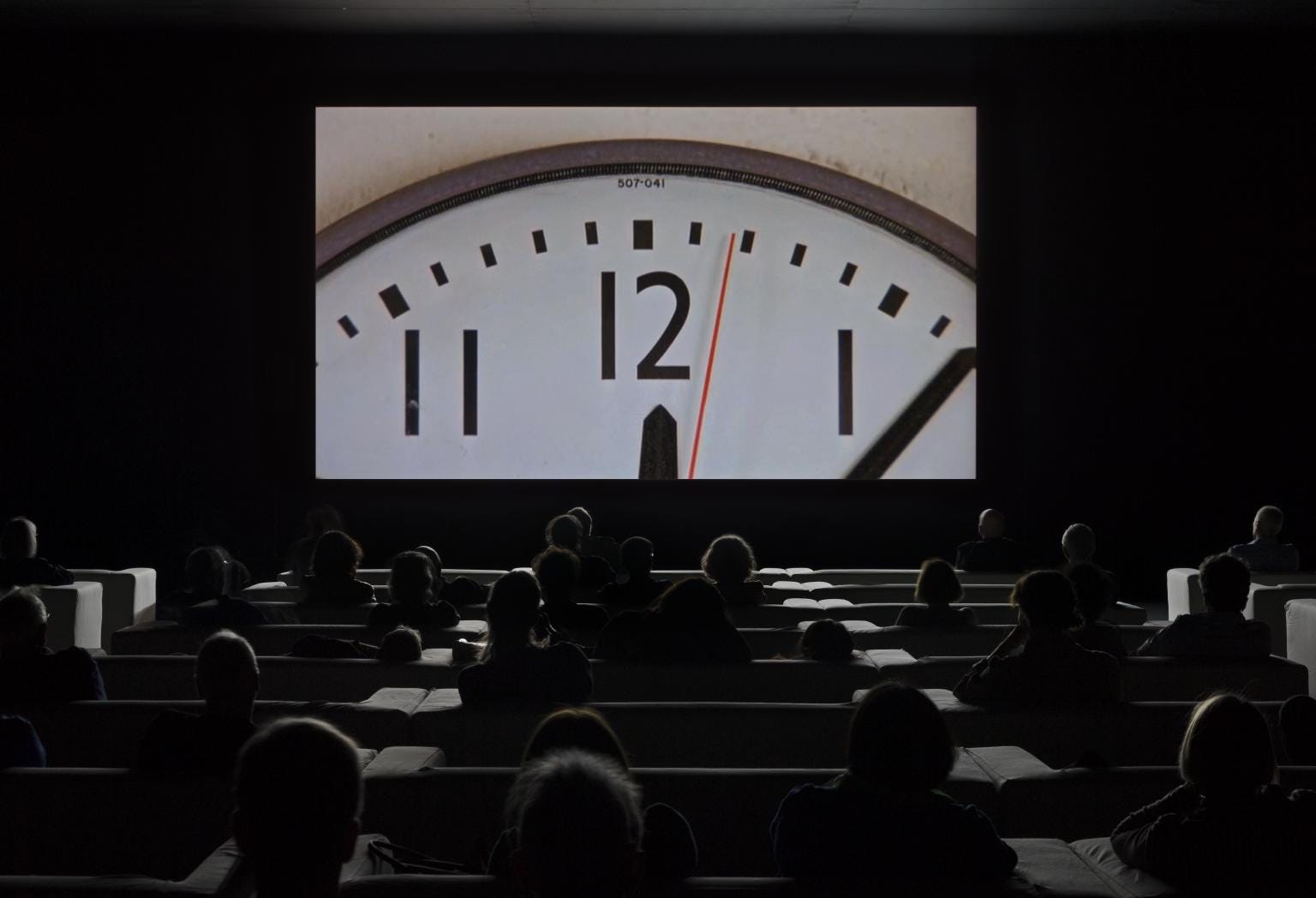
I first saw Christian Marclay’s “The Clock” in 2018, at the new extension of the Tate Modern, in London. It was the end of one world, and the beginning of another.
London was a construction site, as it has maybe always been: the ghostly mussel and clam tones of wet stone architecture contrasted by bright orange and red, cones and signage demarcating work zones, the imperial blue of scaffolding, the lightning yellow of hi-vis equipment finalizing this capitalist empire in awesome, uncanny surfaces of the glass cubes that seemed to grow like mushrooms, the cubes encasing the city in a sort of zoo enclosure. London’s transparent embrace of global wealth solidified in steel and glass, and the dream of London gave way to the foggy morning commute from Archgate, where Douglas Adams and Karl Marx are buried, to midday, wandering into shadowy museums displaying skulls and shrunken specimens in jars, the giant open surface of Audobon’s handpainted birds, and the drunken suits in the dark afternoon hobbling home through Soho after a meal of £4 pints (this was considered flagrantly expensive at the time) and gulps of hot air.
Here is the gist: The Clock is physically a clock. It is a sequence of moving images comprising 24 hours. It is stored inside a hardware computer as opposed to, say, a 35mm reel. The moving images are synced to an external measure of time, thus this piece of media has none of the navigational functions of linear storytelling formats like novels, VHS cassettes, and DVDs.
With MIDI, a digital music protocol that allows for synchronous tempo, the device that adheres strictly to the count of another is referred to as the “slave”. The Clock is an object that is a slave.
Debuted at the White Cube in 2008, all of the viewing rooms for The Clock are always the same. There are rows of Ikea couches and walls of black felt. Since most museums keep daytime hours, much of the film will remain a mystery to much of the public. The strange hours of after midnight are the most deeply enticing, and therefore the most inaccessible.
In 2018, I saw 10:00AM-1:00PM. I talked about the experience to anyone who would listen. Later in the week, I took my friend Danny, and we sat for 6:30PM-9:00PM. In 2025, when the film showed at MoMa, I saw 2:00PM-5:00PM. In total, about the half the time someone is typically awake on any given day.
The filmmaker Chantal Ackerman once boldly remarked that by viewing her film she was, in practical terms, stealing from you “two hours of your life”. Can the vampiric atrophy of “watching”—and it’s undeniable that since so much of our time is spent in front of screens, we are both blissfully ignorant and deeply self conscious of how and what we watch—be alleviated by consuming all of cinema at once? Time spent watching The Clock reminds us of how we, as economic and biological units, are beholden to time. This is a decision we make.
During the experience of this essay, I returned to Ben Lerner’s 10:04, a novel that I had at some point begun and abandoned, evidenced by the bookmark from Novel, a bookseller in Memphis, Tennessee, indicating I had purchased it likely four or five years ago. Armed with greater distance and context, I found that Lerner’s preoccupation with the vertigo of time suffuses 10:04, and I was confronted with an uncanny sense that I had sublimated the novel’s contents without being fully aware of it.
10:04 is titled after a scene from Back to the Future. This reference sits deeply nested inside of a speech within a speech that is itself suggested to be a temporal projection of the author-narrator. In one crucial scene, the narrator meets a friend in order to to discuss their ongoing concerns of Millennial adulthood, while also trying to watch as much of Marclay’s The Clock as possible during the film’s first run at MoMa (winter 2013). The narrator of 10:04’s experience of the film is remarkably similar to my own, including the fact that he arbitrarily chooses to leave at an exact hour mark. Could it be that I read Lerner’s novel before seeing Marclay’s film, and my own viewing experience somehow scrubbed off some autofictive residue from the collective memoriplasm I share with this award-winning offer?
At one point during the screening, the narrator checks the “time” by glancing at his phone. The absurdity of this tic brings him out of the moment:
“I’d heard The Clock described as the ultimate collapse of fictional time into real time, a work designed to obliterate the distance between art and life, fantasy and reality. But part of why I looked at my phone was because that distance hadn’t been collapsed for me at all; while the duration of a real minute and The Clock’s minute were mathematically indistinguishable, they were nevertheless minutes from different worlds.”
In his novel Austerlitz, W.G. Sebald (whom Lerner indicates as a significant influence, going as far as adopting Sebald’s stylistic convention of printing low-res images throughout his novels) notices the monument we build to industrial time, channeling his lamentation of some loss of innocence through the eponymous narrator:
“a mighty clock, the dominating feature of the buffet, with a hand some six feet long traveling round a dial which had once been gilded, but was now blackened by railway soot and tobacco smoke. During the pauses in our conversation we both noticed what an endless length of time went by before another minute had passed, and how alarming seemed the movement of that hand, which resembled a sword of justice, even though we were expecting it every time it jerked forward, slicing off the next one-sixtieth of an hour from the future and coming to a halt with such a menacing quiver that one’s heart almost stopped.”
According to Austerlitz, a wandering intellectual when the narrator meets him, whose travels bring him closer to confronting the terrible secret history of his family, and their fate at the hands of the nazis:
“…all travelers had to look up at the clock and were obliged to adjust their activities to its demands. In fact, said Austerlitz, until the railway timetables were synchronized the clocks of Lille and Liège did not keep the same time as the clocks of Ghent and Antwerp, and not until they were all standardized around the middle of the nineteenth century did time truly reign supreme. It was only by following the course time prescribed that we could hasten through the gigantic spaces separating us from each other…”
Austerlitz never wears a watch, he claims, calling it…
“a thoroughly mendacious object, perhaps because I have always resisted the power of time…in the hope…that time will not pass away, has not passed away, that I can turn back and go behind it, and there I shall find everything as it once was, or more precisely I shall find that all moments of time have co-existed simultaneously, in which case none of what history tells us would be true, past events have not yet occurred but are waiting to do so…”
One would be so lucky to have a friend of such pretensions. Again and again, it would seem that Ben Lerner’s protagonists exhibit similar ambitions: to circumvent the passage of time, to subvert the exhausting waves of fashion, the gigantic yaw of the political pendulum, all of these ruts in the surface of spacetime that we often discover ourselves to be bound to like mules on a millstone.
10:04PM
In a podcast interview with Art Report (2018), Marclay points out that The Clock is a history of London’s video rental stores (all of which have since closed) where the artist and his team farmed the clips to construct this massive assembly of 20th Century cinema. Marclay played no part in this enormous indexing project; his time was entirely spent editing, to the point that he developed various physical frailties common of office workers and compulsive computer users. His chosen medium has always been the readymade, for which he identifies Marcel Duchamp as a key point of inspiration.
Within this rush of information, we understand the patterns of our day-to-day, but also the patterns of our society. Unitary time is an essential variable in basic economic calculations: productivity, efficiency, speed (measures of economic output) are rates, meaning they are mathematically represented as quantities using time as the denominator. Because of this, so much of Marclay’s clock observes a cinema depicting industrial work. We are in the city where numbers are crunched, deals cuts, and heists planned; the Wild West, where the clock denotes the hour of mortal confrontation, depicts the history of fringe towns set up to support frontier workers and entrepreneurs in overalls; even the world of the uberwealthy, familiar to us all now as cloistered and openly flagrant, makes an occasional appearance when some underling or captured secret agent is drawn into a messianic throne rooms aboard a yacht.
The Clock lasts forever and passes too quickly. We see that so much of our time is in fact compressed between the first and last 15 minutes of an hour, as a deadline approaches, or a meeting must be rushed to, or a bomb must be diffused before it blows up a bank, skyscraper, planet, etc.
We see the agitation of 3:00PM and 4:00PM, when the working animal has long exhausted any capacity for rapid insight, and communication withers as the group animal cobbles together their remaining collective brain cells. At 5PM, quittin’ time in the Western World (or at least, the world of long 20th Century Cinema, which precedes our more present hairy reality of unstructured digital work evening), there is a sudden euphoria: it’s time for happy hour! The tellers window comes down, the open sign flips over, and the streets outside become swollen rivers.
So much of cinematic time is tied to the chase. Something the hero desperately seeks is just around the corner, waiting for them. In the nick of time. Before time’s up.
In our cultural understanding of time, something must always be done “before”—before the hour turns over and the nature of the world itself transforms, because it is understood that one minute is not the same as the one before it, and that what is lost to time can never be reclaimed.
Marclay’s film is ultimately a cinematic history of work and industry. There is of course a history of cinema that disregards industry entirely, where mythic tales are told, and free spirits run their fingers through golden, pastoral fields, but none of this is essential to the story depicted in The Clock, because clocks are the masters of work.
Gandalf will never appear in any of the thousands of clips assembled by Marclay’s team because Gandalf, like Austerlitz, never wears a watch. A wizard, after all, arrives exactly when he intends to.
How Do We Know We are Having an Experience?
Contrary to the discrete sanctity suggested by our date system, there is discussion as to when, exactly, the 20th century “ended”. As one era flows into the next, some things serve as definite markers, such as the mass adoption of new technology, or shifts in political power. Some suggest that global catastrophes define our times, as they traumatize the citizenry, who turn away from archaic philosophies and make room for radical reinvention, assisted by new methods of communication and media.
The term “long century” was first proposed by historians to cover a period from 1789 to 1914, beginning with the French Revolution and ending with World War I. The idea being that there is a symbolic century, containing The proposed “long 20th century”, covered in Giovanni Arrighi’s book, projects an end date for this current era as the inevitable erosion US global hegemony, assisted by globalized finance, the centralization of wealth in a small, powerful elite, and the declining hegemony of American culture ceding influence to the East.
Many historians have proposed discrete dates by which we may discern a transition from the century of American hegemony into the new world we inhabit today: the rise of TikTok and AI, for instance, or perhaps earlier, on September 11th, 2001, a deep wound that jettisoned the future, miring American identity in a feedback loop of anxious suspicion, where we increasingly came to see friends as enemies, and citizens as aliens. Others suggest the election of Barrack Obama, which began as some symbolic promise of transcending racial and political boundaries, and ended with a deep sense of pessimism within the American political system, as it became clear that even the most erudite and visionary leader of our era could become handicapped by politics.
It is this long 20th Century that I believe Marclay depicts on screen in The Clock. We see hope and despair in the span of minutes, as familiar faces age and change, heroes and villains come back from the dead, and above the baroque vestige of our rich civilization, time reigns supreme. It is fitting, then, that cinema seems to have died along with the 20th Century.
Films continue to be made, but the experience of watching a video has become poisoned by the smartphone, with its tiny screen and incessant advertisements, the short form video battering the viewer with obscene images, many of them having no origin in any reality we could call our own.
A New Door Opens
At the Brooklyn Museum, Marclay’s new work, Doors, is in some ways a sequal to The Clock. At least superficially, it exhibits a similar construction: a sequence taken from a large archive of films, which play without narration or explanation, allowing the viewer to become lost in history.
Both due to the its subject matter and the media environment into which it has been unleashed, the experience of watching Doors is profoundly different.
Doors exclusively depicts the moment in which someone passes through a threshold. Here we have a doom scroll of monomania: open the door, walk through, close the door, repeat. This ordinary behavior is magnified to the point of semantic satiation; we are forced to consider what exactly a “door” serves to separate. In the film, it is not just two rooms. Worlds exist beyond doors, as to decisions. Life and death hang in the balance.
Notably, the film is edited for spatial continuity. When someone opens a door outwards the next shot (often a completely different person) will the door closing from the same angle and in the same direction. In the language of filmmaking, this editing convention conserves continuity; it’s one of many generally accepted principles within the “grammar” of filmmaking, along with the 30% rule, the “rule of thirds”, etc. We are dealing with a composition that embraces certain traditional filmmaking constraints in order to take broader liberties with respect to narrative. It is therefore a film of pure movement.
Doors suggests a world in which there is no time, and also, crucially, nothing ever happens. There are many similarities to The Clock, in terms of what the film teaches us about storytelling. Like time, doors often impede or enable crucial moments of plot, humor, and interaction between individuals. There are, of course, many many chase sequences, where a screaming woman evades an unseen pursuer. Cops run after robbers, spy chases spy, a well-dressed man on holiday is not who he may seem….
Sound travels between dimensions and universes as well, creating the eerie sensation that there is in fact one single protagonist of the film, and this shapeshifting entity is caught in a strange liminal hell, where they flit through the world like a quantum paradox, never arriving anywhere or resolving any conflict.
Diverging from a well-defined structure, Doors play out in a similar fashion to the endless reel of short-form video to which we are all well-acquainted. It is an endless loop. But not the circular loop of a clock…moreso a strange loop, which seems to pass through dimension and space, intersecting and diving deeper into itself like a Klein Bottle, or a fractal.
Have you noticed how Instagram Reels often begin in the middle, with the beginning action coming at the end, right before the video loops around? Hopefully not, hopefully you don’t watch Instagram Reels. Anyway, this is of course a ploy designed to ensure the audience rewatches, hopefully many times over, ensuring a high view count.
A trick employed by Marclay is though occasional repetition—he inserts the same clip at unexpected times, making it impossible for the audience to deduce a meta-structure beyond the simple rule that the scene will change when the doorway is crossed. This conceit also makes it impossible to know when the film “ends.”
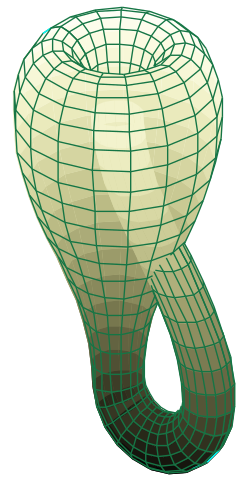
The Klein Bottle suggests an unusual topological path back to the beginning
OK So What Is Happening Right Now?
One clever reviewer in the Guardian notes that Marclay has exceptionally good timing, used both in reference to comedic pacing, and also how his works seem to arrive on the cusp of tremendous upheavals in our collective experience of media. The Clock arrived right at the end of the era of physical media, and Doors just before the proliferation of endless scroll. The former feels like a distinctly “contemporary” work of art, in that it seems made almost exclusively for display at blue chip museums (as I mentioned earlier, The Clock is a physical object, of which only 10 editions exist, each one costing upwards of $10 million), whereas the latter feels much more liminal, like a meme come alive and run amok in the gallery space. Doors would sit comfortably next to many of the multimedia works on display at The Whitney’s 2026 Biennale, which was widely criticized for the lack of coherence and perceived pointlessness of many of the works.
But liminality is in vogue, as is “slop”, pointlessness, inanity, brainrot, folly, repetition, and why not? A century ago, a fascist military party rose to power with the promise of taking over the entire world, and it was only through the manifestation of mankind’s most destructive impulses that this sinister goal was averted. The fascists of today present a much more myopic goal: to separate themselves from everyone else, close their borders, and cloister their economies. It makes sense that the aesthetic representations of such stasis are patterns examined to the point of madness.

One well-documented work from the Venice Biennale, SEAWORLD by Florentina Holzinger, depicts a nude woman riding a jetski in circles, like a caged lion pacing in its enclosure.
In a recent interview with Joshua Citarella, the artist and writer Hito Steyerl notes that the trajectory of the Contemporary Art movement also tracks the beginning and end of the neoliberal project of the Global West—beginning in the 1970s and ending with the election of Donald Trump in 2016. It’s a complex and nuanced argument, worth listening to, but the gist I gather is that, at art fairs such as the Venice Biennale (an event ordinary people rarely attend, not to say that they would have much interest in the “art” on display anyways, divorced as it is from any traditional decorative application most people associate with artwork), artists and their work are used as political tools (nothing new here), tokens of soft power among large, powerful democracies, as well as nation states that give no pretense of being democratic, but would like to maintain some sheen of cultural discourse in order to benefit from access to Western Democratic capital markets.
Steyerl makes the somewhat trite suggestion that online betting markets—broadly unregulated and clearly subject to exploitation by the oddsmaking ruling classes—may replace art as a means of speculative value storage (and by extension, tax evasion). While fleeting vehicles for speculation such as NFTs are openly vacuous and cynical in their value proposition, Doors is markedly nostalgic. There is a bogeyman haunting the hallways of the abandoned hospital. It’s right there, just out of reach, and perhaps even out of time…but it will reach out to grab you if you don’t open the next door.
Speaking of Things Neverending
One weekend eight years ago, I traveled north of London on the train, disembarking at the Waverly station, where a extensive steel truss held aloft sheets of glass, which protected travelers from the rain, just as they done in my days as a student. I had graduated university in Edinburgh in the summer of 2017. Upon my return, I discovered that I did not feel any sense of nostalgia towards the city at all. Many of my friends had moved on. The days were dreary, and the dramatic city that had once inspired majestic charm and mystery were now so familiar as to be relics.
During the day, my friend and host Andrey rose in the morning and went to work. I was not so beholden to time. I wandered the docks of Leith, which had transformed in my absence as the formerly working class neighborhood underwent gentrification. I made the long walk from New Town across the volcanic chasm of the Royal Mile, into the grand city park of the Meadows, up the hill into Morningside, passed my former flatshare on Morningside Road by the Canny Man, and down again towards the Braid, where as a student I used to jog. There were so many stories and versions of myself lost in these hills. On one of these hills, Blackford Hill, my friends and I once watched the northern lights cross the midnight sky. At its toeslope, in a crop of brutalist buildings dedicated to the sciences, I saw David Nutt, the English neuropsychopharmacologist and advocate for MDMA therapy, give his lecture. On a sign outside the entrance, next to the university emblem, was the namesake of this building, the physicist James Clerk Maxwell.
Despite my failure to embrace any sense of a glorious return, I was comforted by the knowledge that there was nothing left for me to do here. I had completed this part of the journey, about which so many old friends remarked to me that “didn’t it all seem like a dream?” (Oh please, don’t say it...), and it all passed over me like a plane flying overhead, deafening and wonderful, filled with passengers who were on their own journey.
I had passed through doors and doors, and I had measured my progress against the ticking of so many clocks. In another universe, I am still in the theater, watching the patterns unfold, attempting to make sense of it all.
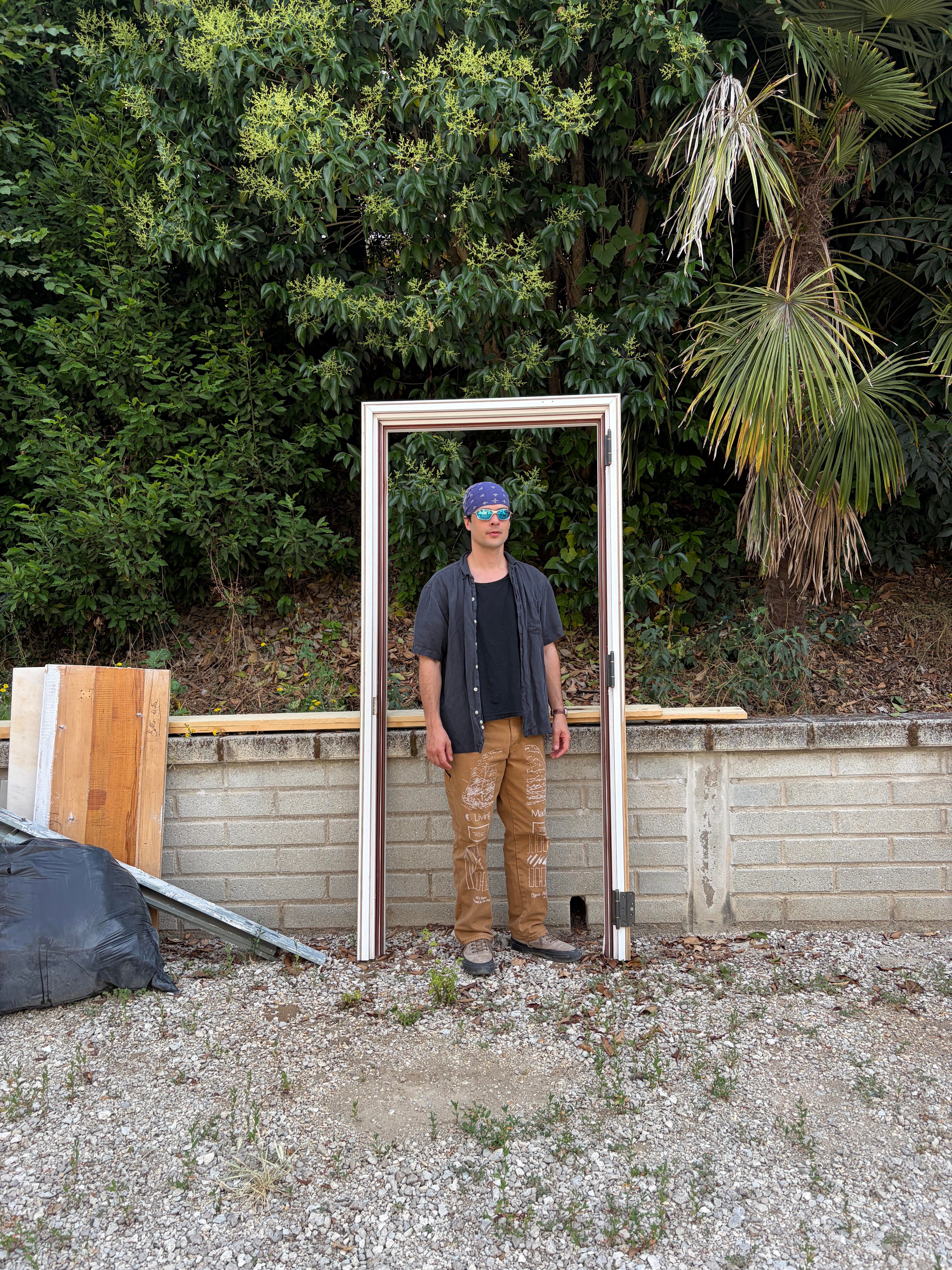
Last known location of the author before proceeding through a door.